
Why Web Design Trends Matter for Business Leaders in 2026
Web design is no longer just a concern for developers and creative teams — it’s a strategic business decision. In 2026, the digital landscape is evolving faster than ever, and the websites that succeed are those built with intentionality, user empathy, and a clear understanding of emerging design principles. For decision-makers, understanding these trends isn’t about chasing aesthetics — it’s about driving conversions, building trust, and staying competitive.
This guide breaks down the most impactful web design trends of 2026, with practical insights on what they mean for your business and how to prioritize them effectively.
1. AI-Driven Personalization at Scale
Artificial intelligence has fundamentally changed how websites interact with visitors. In 2026, AI-powered personalization is no longer a luxury reserved for enterprise-level companies — it’s an expectation. Websites now dynamically adapt content, layout, and calls-to-action based on user behavior, location, device, and even browsing history.
For decision-makers, this means investing in platforms and tools that support real-time content adaptation. The payoff is significant: personalized experiences consistently outperform static ones in engagement, time-on-site, and conversion rates. If your website is still serving the same generic homepage to every visitor, you’re leaving measurable revenue on the table.
- Dynamic content blocks tailored to user segments
- AI-generated product or content recommendations
- Behavioral triggers that adjust CTAs and messaging
2. Minimalism With Maximum Impact
Clean, purposeful design continues to dominate in 2026, but this year’s minimalism is more intentional than ever. It’s not about removing elements for the sake of simplicity — it’s about ensuring every visual component serves a clear purpose. Whitespace, bold typography, and restrained color palettes are being used to guide user attention with precision.
Decision-makers should recognize that cluttered websites erode trust. When users land on a page overloaded with information, they bounce. Modern minimalism ensures that your key messages and conversion paths are immediately visible, reducing cognitive load and increasing the likelihood of meaningful user action.
3. Immersive Micro-Interactions and Motion Design
Subtle animations and micro-interactions — the small visual responses triggered by user actions — have become a hallmark of premium web experiences in 2026. Hover effects, scroll-triggered animations, and interactive feedback loops make websites feel alive and responsive, fostering a deeper emotional connection with the brand.
The business case for motion design is clear: it increases user engagement and dwell time. However, the key is restraint. Overly aggressive animations can slow down page load times and frustrate users. Decision-makers should ensure their design teams are balancing visual delight with performance optimization.
- Scroll-triggered content reveals
- Animated button feedback on click or hover
- Smooth page transitions that reinforce brand identity
- Loading animations that reduce perceived wait times
4. Accessibility as a Core Design Requirement
In 2026, accessibility is not optional — it’s both a legal standard and a business imperative. Web Content Accessibility Guidelines (WCAG) compliance is increasingly enforced globally, and companies that fail to meet these standards risk litigation, reputational damage, and the exclusion of a significant portion of potential customers.
Beyond compliance, accessible design is simply good design. High color contrast, keyboard navigability, descriptive alt text, and screen reader compatibility all contribute to a better experience for every user — not just those with disabilities. Decision-makers should treat accessibility as a foundational investment, not an afterthought.
Conducting regular accessibility audits and including diverse user testing in your QA process is the most effective way to ensure your site meets modern standards and serves your entire audience.
5. Mobile-First Is Now Mobile-Only Thinking
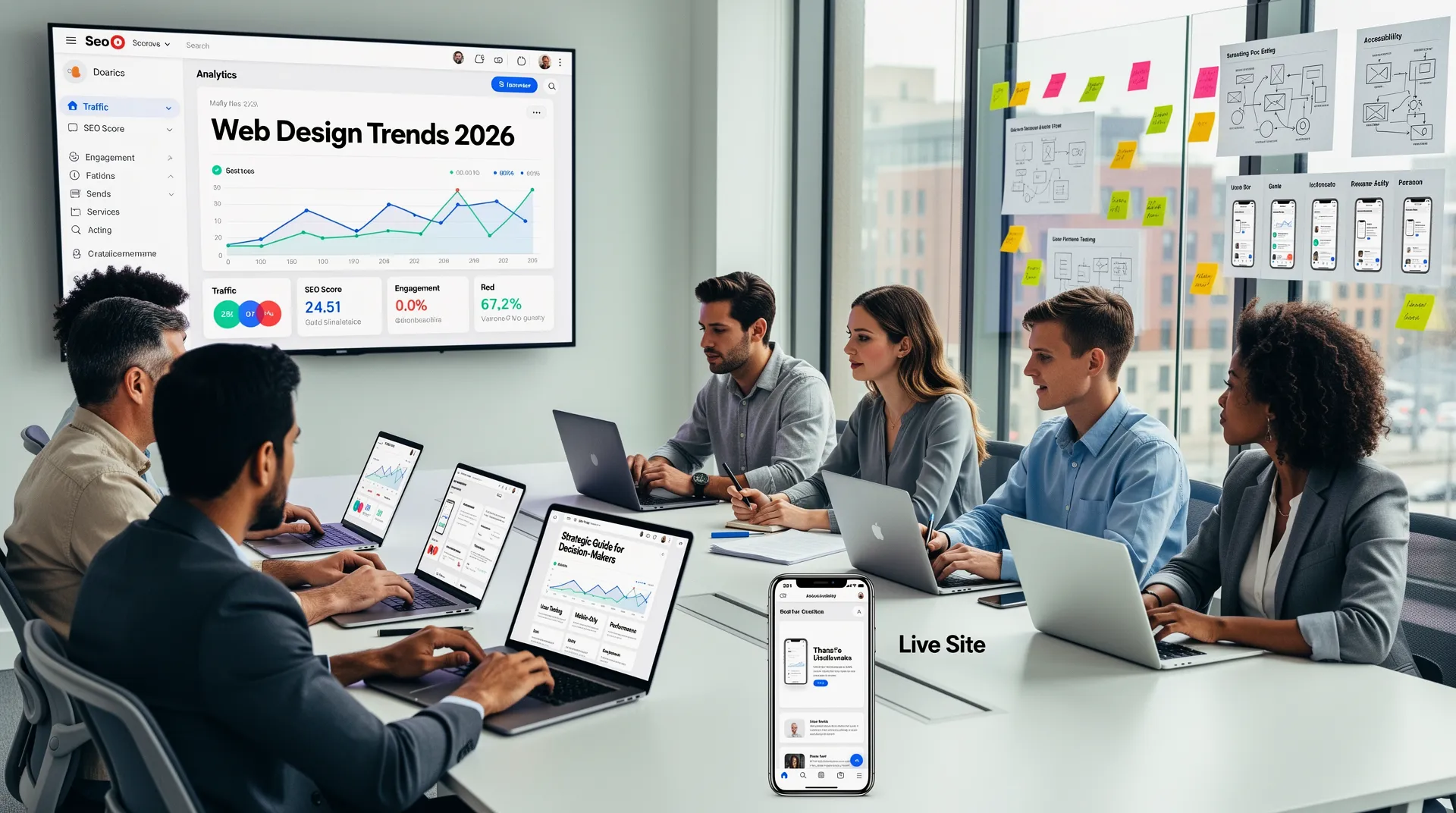
The shift from mobile-first to mobile-centric design is complete. In 2026, the majority of web traffic globally originates from mobile devices, and search engines continue to prioritize mobile performance in their ranking algorithms. Designing for desktop and adapting for mobile is an outdated approach that results in poor user experiences and lower search visibility.
Decision-makers need to ensure their teams are designing mobile experiences from the ground up — with thumb-friendly navigation, fast load times, and streamlined content hierarchies. Core Web Vitals remain a critical benchmark, and sites that consistently score well see tangible SEO benefits.
- Prioritize touch-friendly UI elements and navigation
- Optimize images and assets for mobile bandwidth
- Ensure fast load times (under 2.5 seconds) on mobile networks
- Use progressive web app (PWA) technology where appropriate
6. Dark Mode and Adaptive Color Schemes
Dark mode has matured from a novelty feature to a mainstream user preference in 2026. Many users now expect websites to honor their system-level display preferences automatically. Adaptive color schemes that seamlessly switch between light and dark modes not only improve user comfort but also signal that your brand pays attention to detail.
From a business perspective, implementing dark mode properly requires thoughtful design — logos, images, and UI components must all be optimized for both display modes. Decision-makers should factor this into design budgets and timelines when planning website updates or rebuilds.
7. Sustainability and Performance-Driven Design
Digital sustainability has emerged as a genuine consideration in 2026. As awareness of the internet’s carbon footprint grows, businesses are increasingly scrutinizing the environmental impact of their digital presence. Sustainable web design — characterized by leaner code, optimized assets, and energy-efficient hosting — also delivers direct performance benefits.
Faster, lighter websites rank higher in search results, convert better, and cost less to operate. Sustainable design is a win-win: it’s better for the planet and better for your bottom line. Decision-makers should ask their development teams about image compression strategies, code efficiency, and green hosting options.
How to Prioritize These Trends for Your Business
Not every trend will be equally relevant to your organization. The key is to evaluate each through the lens of your specific business goals, audience, and technical capacity. Here’s a practical framework for prioritization:
- Start with accessibility and mobile optimization — these have the broadest impact and carry compliance implications.
- Invest in AI personalization if your site handles significant traffic volume and you have the data infrastructure to support it.
- Incorporate minimalism and motion design during your next visual refresh or redesign cycle.
- Address dark mode and sustainability as part of ongoing performance optimization efforts.
The Bottom Line for Decision-Makers
Web design in 2026 is where brand identity, user experience, and business performance converge. The trends outlined in this guide aren’t fleeting aesthetic choices — they represent proven approaches to building digital experiences that users trust, enjoy, and act upon. Decision-makers who treat their website as a strategic asset — rather than a static brochure — will be best positioned to capitalize on these developments.
Whether you’re planning a full redesign or incremental improvements, use this guide as a strategic framework to align your web design investments with measurable business outcomes. The most successful digital brands in 2026 are those that move with purpose, balancing innovation with usability at every step.

No comments yet — be the first