

Introduction: Why Staying Ahead of SEO Trends in 2026 Matters
The world of search engine optimization is evolving faster than ever. As we move through 2026, the strategies that once guaranteed top rankings are being replaced by smarter, more user-centric approaches. Search engines like Google are deploying increasingly sophisticated algorithms, and businesses that fail to adapt risk losing their digital visibility entirely.
Understanding the key SEO trends of 2026 is not just a competitive advantage — it is a necessity. From artificial intelligence reshaping how content is evaluated, to the rise of zero-click searches and voice-driven queries, this guide breaks down the most impactful shifts every SEO professional and website owner needs to embrace right now.
1. AI-Powered Search and Generative Engine Optimization (GEO)
Artificial intelligence has fundamentally transformed how search engines process and rank content. In 2026, AI-driven search experiences — including Google’s Search Generative Experience (SGE) and Bing’s AI-integrated results — are no longer experimental features. They are the norm.
This has given rise to a new discipline known as Generative Engine Optimization (GEO). Unlike traditional SEO, GEO focuses on ensuring that your content is structured and authoritative enough to be cited or summarized by AI-generated search responses. To succeed in this space, content must be:
- Deeply informative and well-researched
- Structured with clear headings and concise answers
- Backed by credible sources and author expertise
- Optimized for featured snippets and knowledge panels
Brands that treat GEO as a core part of their strategy are far more likely to appear in AI-generated overviews, which now dominate the top of many search result pages.
2. E-E-A-T: Experience, Expertise, Authoritativeness, and Trustworthiness
Google’s E-E-A-T framework has become a central pillar of content quality evaluation in 2026. Search algorithms now place significant weight on the demonstrated experience of content creators — not just their expertise. This means firsthand knowledge, real-world case studies, and authentic author profiles are more valuable than ever.
To strengthen E-E-A-T signals on your website, consider the following actions:
- Publish detailed author bios with credentials and professional history
- Incorporate original research, data, and case studies into your content
- Earn backlinks from reputable industry publications
- Ensure your website has a clear and transparent privacy policy and contact information
- Regularly update older content to reflect current information
3. Voice Search and Conversational Query Optimization
With the widespread adoption of smart speakers, virtual assistants, and AI chatbots, voice search has become a dominant mode of information retrieval. In 2026, optimizing for conversational queries is essential for capturing this growing segment of search traffic.
Voice searches tend to be longer, more natural in phrasing, and often phrased as questions. To align your content with this behavior:
- Target long-tail, question-based keywords (Who, What, How, Why, When)
- Write content in a conversational tone that mirrors natural speech patterns
- Create FAQ sections that directly answer common user queries
- Optimize for local intent, as many voice searches are location-specific
4. Core Web Vitals and Technical SEO Performance
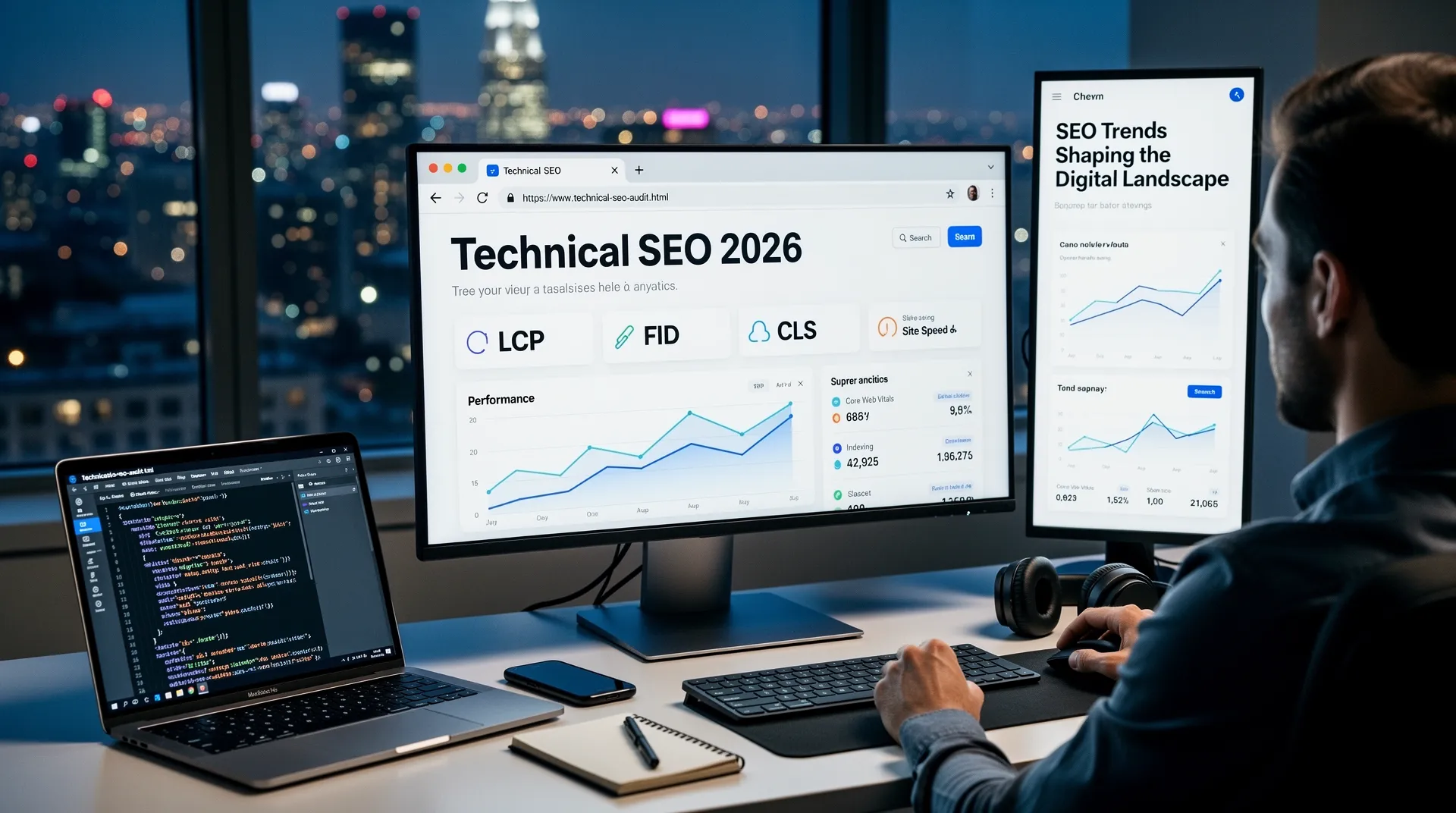
Technical SEO remains a cornerstone of search performance in 2026. Google’s Core Web Vitals — measuring page load speed, interactivity, and visual stability — continue to serve as ranking signals that can make or break a website’s position in search results.
The key Core Web Vitals metrics to prioritize include:
- Largest Contentful Paint (LCP): Aim for under 2.5 seconds for the main content to load
- Interaction to Next Paint (INP): Replaced FID as the measure of responsiveness; target under 200 milliseconds
- Cumulative Layout Shift (CLS): Keep visual instability below 0.1 to ensure a smooth user experience
Beyond these metrics, technical SEO in 2026 also demands attention to structured data markup, crawlability, mobile-first indexing, and HTTPS security. Websites that deliver a seamless, fast, and secure experience consistently outperform those that neglect the technical foundation.
5. Zero-Click Searches and SERP Feature Optimization
A significant proportion of Google searches in 2026 end without a user clicking through to any website. These zero-click searches — where answers are provided directly on the results page via featured snippets, knowledge graphs, or AI overviews — represent a major challenge for organic traffic generation.
Rather than viewing zero-click as a threat, forward-thinking SEO strategies treat it as an opportunity for brand visibility. To maximize your presence in SERP features:
- Structure content to answer specific questions directly and concisely
- Use schema markup to help search engines understand your content’s context
- Optimize for “People Also Ask” boxes with layered, informative answers
- Build brand recognition so users actively seek out your website even after seeing an AI summary
6. Video SEO and Multimodal Content
Search engines in 2026 are increasingly multimodal — meaning they can process and rank not just text, but images, videos, and audio content as well. Video SEO has emerged as one of the most powerful traffic drivers, with video carousels and YouTube results appearing prominently across a wide range of search queries.
To leverage video SEO effectively:
- Optimize video titles, descriptions, and tags with relevant keywords
- Add accurate transcripts and closed captions to improve accessibility and indexability
- Create short-form video content that answers specific search queries
- Embed videos on relevant web pages to boost time-on-page metrics
7. Hyper-Personalization and Search Intent Alignment
Understanding why a user is searching — not just what they are searching for — is the foundation of modern SEO. In 2026, search engines are exceptionally adept at distinguishing between informational, navigational, transactional, and commercial investigation intent, and they reward content that precisely matches that intent.
To align your content with search intent:
- Analyze the top-ranking pages for your target keywords to understand what format and depth they use
- Create content that serves the specific stage of the buyer’s journey your audience is in
- Use data segmentation and personalization tools to tailor on-site experiences
- Regularly audit your content to ensure it still matches evolving user expectations
8. Sustainable SEO: Building Long-Term Authority
Perhaps the most enduring trend of 2026 is the shift away from quick-win tactics toward sustainable SEO. Algorithm updates have made it increasingly difficult to game the system with low-quality links, thin content, or keyword stuffing. Instead, the brands that thrive are those investing in genuine authority-building over time.
Sustainable SEO practices include developing a consistent content publishing calendar, building authentic relationships for organic link acquisition, focusing on topical authority within a defined niche, and continuously improving user experience across all devices.
Conclusion: Adapt and Thrive in 2026’s SEO Environment
The SEO landscape of 2026 rewards adaptability, authenticity, and technical excellence. From embracing AI-driven search experiences to mastering Core Web Vitals and video optimization, the brands that succeed are those willing to evolve alongside search engine technology. By integrating these trends into a cohesive strategy, you can build lasting digital visibility and stay ahead of the competition in an increasingly complex search ecosystem.
No comments yet — be the first