
The SEO Landscape in 2026: A Turning Point
Search engine optimization continues to evolve at a breathtaking pace. In 2026, the rules of the game have shifted significantly — driven by artificial intelligence, changing user behavior, and Google’s ever-more-sophisticated algorithms. To stay competitive, businesses and marketers must understand and act on the trends defining this year’s SEO landscape. Below, we break down the most important developments you cannot afford to ignore.
1. AI-Generated Content and the Quality Imperative
Artificial intelligence tools have made content creation faster and more accessible than ever before. However, in 2026, quantity alone is no longer a winning strategy. Search engines have become remarkably adept at distinguishing between shallow, AI-spun content and genuinely valuable, authoritative material.
Google’s algorithms now reward content that demonstrates real expertise, lived experience, and depth of insight — the cornerstones of its E-E-A-T framework (Experience, Expertise, Authoritativeness, and Trustworthiness). Brands that invest in human oversight, factual accuracy, and original perspectives on top of AI assistance will consistently outperform those relying on automation alone.
- Use AI as a drafting and research tool, not a replacement for expert knowledge.
- Always add unique data, case studies, or first-hand insights to AI-generated drafts.
- Ensure every published piece is reviewed by a subject-matter expert.
2. Search Generative Experience (SGE) and Zero-Click Searches
Google’s Search Generative Experience (SGE) has fundamentally altered how users interact with search results. AI-powered answer boxes now appear at the top of many search result pages, providing direct responses to user queries without requiring a click-through to any website.
This shift has caused a notable rise in zero-click searches. While this may seem alarming, it also represents a significant opportunity. Websites that are cited as sources within SGE responses benefit from enhanced visibility and brand credibility — even without a traditional click.
To optimize for SGE and featured snippet opportunities in 2026:
- Structure your content using clear, concise answers directly after heading tags.
- Use FAQ sections and structured data (schema markup) to signal relevance.
- Focus on becoming a trusted, citable source in your niche.
3. Voice Search and Conversational Queries
The proliferation of smart speakers, voice assistants, and AI chatbots has accelerated the shift toward conversational search. In 2026, a growing share of searches are phrased as natural-language questions rather than short keyword strings.
Optimizing for voice search means thinking about how your target audience actually speaks. Long-tail, question-based keywords have become essential components of any robust content strategy. Pages that directly and concisely answer “who,” “what,” “where,” “when,” “why,” and “how” questions are best positioned to capture this traffic.
- Incorporate question-and-answer formats throughout your content.
- Target conversational, intent-driven phrases in addition to traditional keywords.
- Optimize for local voice searches by keeping your Google Business Profile current.
4. Core Web Vitals and Page Experience Remain Non-Negotiable
Technical SEO has never been more important. Google’s Core Web Vitals — which measure loading performance (LCP), interactivity (INP), and visual stability (CLS) — remain a confirmed ranking factor in 2026. Sites that deliver a fast, smooth, and visually stable experience consistently rank higher than sluggish or poorly optimized competitors.
With mobile devices accounting for the majority of global web traffic, mobile-first indexing is a given. Your site’s mobile experience is not an afterthought — it is the primary lens through which Google evaluates your pages.
- Regularly audit your Core Web Vitals using Google Search Console and PageSpeed Insights.
- Prioritize server response times, image optimization, and efficient JavaScript loading.
- Eliminate layout shifts caused by ads, embeds, or dynamically injected content.
5. Entity-Based SEO and Semantic Search
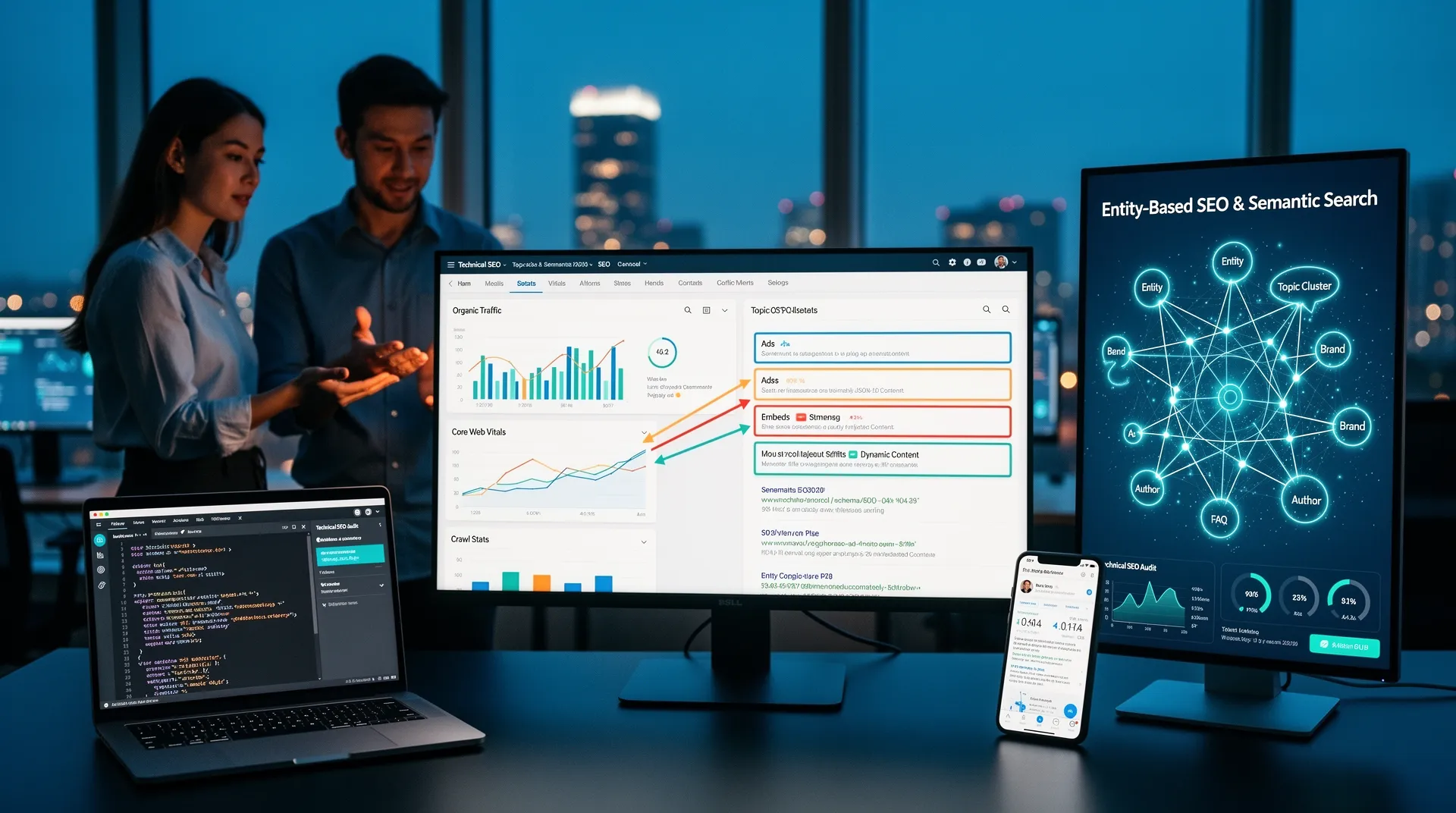
Google’s understanding of content has matured well beyond simple keyword matching. In 2026, the search engine thinks in terms of entities — people, places, concepts, and their relationships — rather than isolated words. This means that building topical authority across a subject area is far more effective than targeting individual keywords in isolation.
Semantic SEO involves creating interconnected content clusters that collectively signal deep expertise on a given topic. A well-structured internal linking strategy, combined with comprehensive coverage of related subtopics, sends powerful relevance signals to search engines.
- Build topic clusters around your core services or areas of expertise.
- Use structured data to help search engines understand the entities on your pages.
- Ensure your brand is prominently represented in knowledge panels and authoritative directories.
6. Video SEO: A Rapidly Growing Channel
Video content has cemented its place as one of the most powerful formats for both user engagement and search visibility. In 2026, video results appear prominently across Google Search, YouTube, and AI-generated answer experiences. Brands that invest in video SEO gain access to a wider surface area of search real estate.
Optimizing video content for search requires more than simply uploading to YouTube. Proper use of titles, descriptions, chapters, transcripts, and schema markup ensures that search engines can fully index and understand your video content.
- Add detailed, keyword-rich descriptions and timestamped chapters to every video.
- Embed videos on relevant landing pages to increase dwell time and contextual relevance.
- Use VideoObject schema markup to enhance visibility in rich results.
7. Local SEO: Hyperlocal Relevance Takes Center Stage
For businesses serving specific geographic areas, local SEO has become more competitive and more nuanced in 2026. Google’s local ranking algorithm increasingly favors businesses that demonstrate consistent, accurate, and rich information across all digital touchpoints.
Reviews, proximity, and relevance remain the three pillars of local ranking. However, the importance of actively managing your online reputation and engaging with customer feedback has grown substantially. Businesses with a high volume of authentic, recent reviews tend to dominate local pack results.
- Keep your Google Business Profile fully optimized with up-to-date hours, photos, and services.
- Actively encourage satisfied customers to leave detailed reviews.
- Build local citations on authoritative directories to reinforce geographic relevance.
8. First-Party Data and Privacy-First SEO
With third-party cookies largely phased out and privacy regulations tightening across the globe, the ability to collect and leverage first-party data has become a critical competitive advantage. In 2026, SEO strategies are increasingly intertwined with owned data collection — newsletters, gated content, loyalty programs, and community platforms.
Understanding your audience through first-party signals allows you to create more precisely targeted content, improving both relevance and conversion rates. It also positions your brand as trustworthy in an era where data privacy is a core consumer concern.
Looking Ahead: Adaptability Is the Ultimate SEO Strategy
The SEO trends of 2026 share a common thread: they reward brands that prioritize genuine value, technical excellence, and authentic audience connection. Whether it’s optimizing for AI-driven search experiences, doubling down on video content, or building entity authority, the businesses that thrive will be those willing to evolve continuously.
Rather than chasing every algorithm update reactively, invest in a solid strategic foundation — one built on quality content, robust technical infrastructure, and a deep understanding of your audience’s needs. That approach will remain effective no matter how the search landscape continues to shift.
No comments yet — be the first