

Why 2026 Is a Defining Year for Google Ads
The digital advertising landscape is undergoing one of its most dramatic transformations yet. As we move through 2026, Google Ads is no longer just a platform for keyword bidding and banner placements — it has evolved into a sophisticated, AI-driven ecosystem that demands a new level of strategic thinking from every marketer. Staying ahead of these changes isn’t optional; it’s essential for maintaining a competitive edge.
Whether you manage campaigns for a small business or a large enterprise, understanding the forces reshaping Google Ads in 2026 will determine how efficiently your ad spend translates into real business outcomes. Here’s a comprehensive look at the key trends shaping the future of paid search — and what you should be doing about them right now.
1. AI-Powered Campaigns Are Now the Standard
Artificial intelligence has fully taken center stage in Google Ads. Tools like Performance Max (PMax) campaigns have become the dominant campaign type, leveraging Google’s machine learning to automatically optimize bids, placements, and creative assets across all Google channels — including Search, Display, YouTube, Gmail, and Maps.
In 2026, the marketers winning with PMax are those who understand that feeding the algorithm with high-quality data is the real competitive advantage. This includes:
- Uploading diverse creative assets (headlines, images, videos)
- Providing detailed audience signals based on first-party data
- Setting clear conversion goals that align with actual business objectives
- Regularly auditing campaign insights to guide the AI rather than simply trusting it blindly
Marketers who treat PMax as a “set it and forget it” tool are leaving significant performance on the table. Strategic human oversight combined with AI automation is the winning formula in 2026.
2. First-Party Data Has Become the Most Valuable Currency
The decline of third-party cookies has fundamentally altered how advertisers target and track audiences. In 2026, first-party data — information collected directly from your own customers and website visitors — is the backbone of any effective Google Ads strategy.
Brands that built robust data collection systems early are now reaping the rewards. If you haven’t yet, the time to invest is now. Key tactics include:
- Building and growing email lists through valuable lead magnets
- Using Google’s Customer Match to upload and activate your CRM data
- Implementing Enhanced Conversions to improve the accuracy of conversion tracking
- Leveraging Google Tag Manager alongside Consent Mode v2 for compliant data collection
The brands that treat data collection as a marketing asset — not just a backend technical task — are the ones outperforming their competitors on Google Ads in 2026.
3. Search Generative Experience (SGE) Is Reshaping Search Intent
Google’s Search Generative Experience (SGE) has fundamentally changed how users interact with the search engine results page (SERP). AI-generated answers now appear at the top of many search results, pushing traditional organic and even paid listings further down the page.
This shift has profound implications for paid search advertisers. Click-through rates for some query types have shifted, making it more important than ever to focus on high-intent, transactional keywords where users are ready to take action — queries that SGE is less likely to fully satisfy with a generated answer.
Smart advertisers in 2026 are also exploring how their ad copy can complement the SGE experience, ensuring their messaging resonates at every stage of a search journey that increasingly begins with an AI-generated summary.
4. Video and Visual Search Ads Are Exploding in Importance
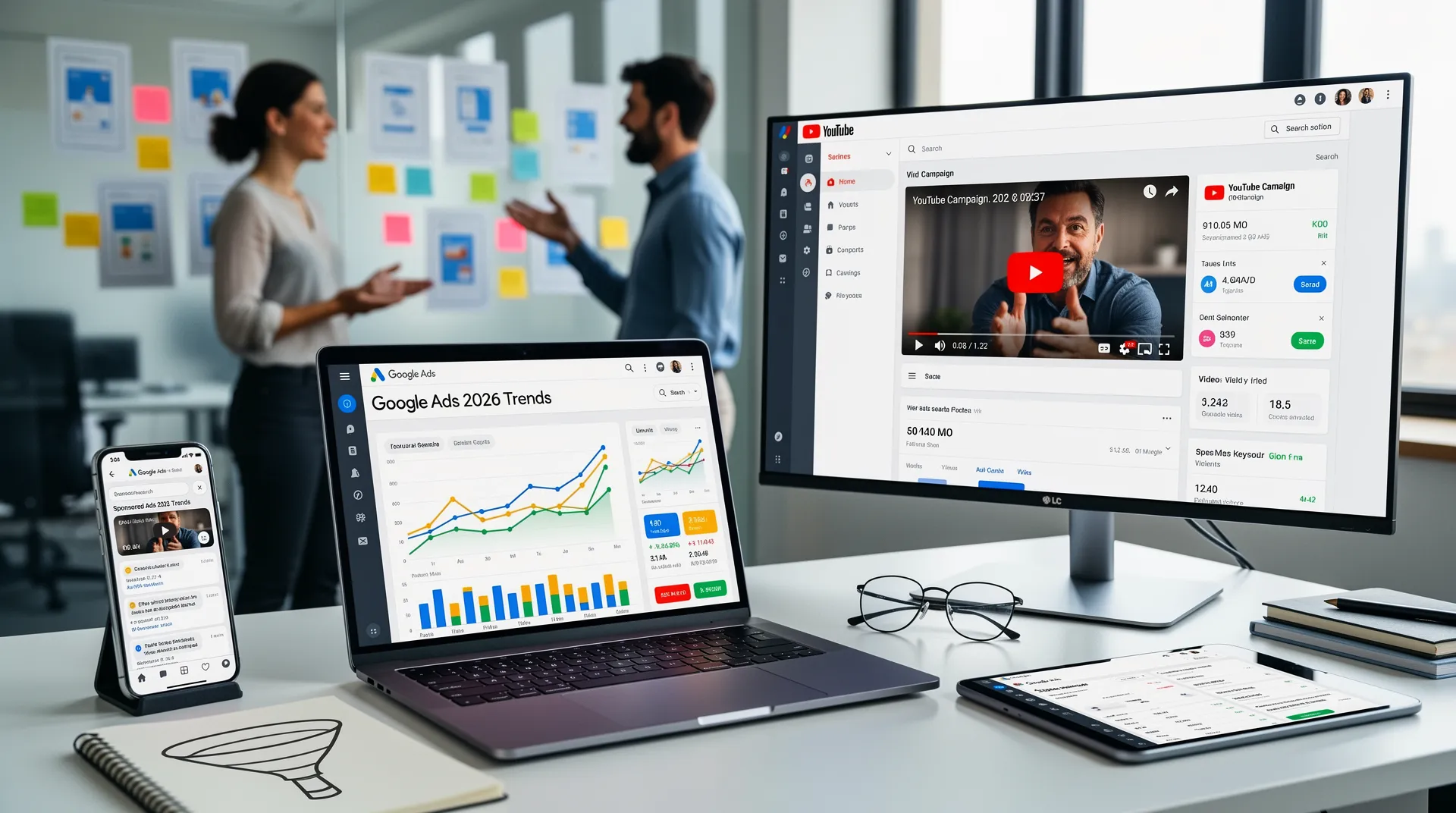
Text-based search ads remain valuable, but 2026 has confirmed that video and visual formats are no longer supplementary — they’re central to a complete Google Ads strategy. YouTube advertising, in particular, has become a critical touchpoint for full-funnel marketing.
Key video ad trends to capitalize on include:
- YouTube Shorts Ads: Short-form vertical video ads are seeing strong engagement as user consumption of Shorts continues to surge.
- Connected TV (CTV) Ads: As more households cut the cord, YouTube on TV screens has become a premium inventory opportunity.
- Demand Gen Campaigns: Google’s Demand Gen campaigns combine YouTube, Discover, and Gmail placements to drive awareness and consideration at scale.
Marketers without a video creative strategy risk being significantly outperformed by competitors who are leveraging these high-engagement formats.
5. Smart Bidding Requires Smarter Goal-Setting
Automated Smart Bidding strategies — Target CPA, Target ROAS, Maximize Conversions, and Maximize Conversion Value — have become more powerful in 2026, but they are only as effective as the goals and data you feed them. A common mistake is optimizing for the wrong conversion event.
For example, optimizing for “add to cart” when your real goal is “purchase” can lead the algorithm to drive irrelevant traffic. Best practices in 2026 include:
- Assigning accurate conversion values to every action
- Using micro-conversions to support campaigns that lack enough final conversion data
- Regularly reviewing your target CPA and ROAS targets to reflect seasonal changes and market shifts
- Avoiding frequent bid strategy changes that reset the algorithm’s learning period
6. Audience Segmentation and Personalization Drive Performance
Generic ad messaging is increasingly ineffective. In 2026, Google Ads’ audience segmentation capabilities allow advertisers to deliver highly tailored messages to specific user groups based on intent signals, demographics, in-market behaviors, and life events.
Effective audience strategies now include layering multiple signals — for example, combining in-market audiences with Customer Match lists to reach high-value prospects who already have familiarity with your brand. Responsive Search Ads (RSAs) further enable personalization at scale by dynamically serving the most relevant headline and description combinations to each user.
7. Privacy-First Advertising Is Non-Negotiable
Regulatory pressure and evolving user expectations around data privacy are reshaping how Google Ads operates globally. Google’s Consent Mode v2 is now a requirement for advertisers in many markets, and non-compliance risks both legal exposure and significant data gaps in conversion reporting.
Marketers must ensure their consent management platforms (CMPs) are properly integrated, and that they have a clear strategy for modeling conversions in cases where users decline consent. Privacy is no longer a compliance checkbox — it’s a core element of a sustainable advertising strategy.
Preparing Your Google Ads Strategy for What’s Next
The pace of change in Google Ads shows no signs of slowing. The trends defining 2026 — AI automation, first-party data, SGE, video advertising, smart bidding, audience personalization, and privacy compliance — are interconnected. Mastering one without addressing the others will only get you so far.
The marketers who will thrive are those who view Google Ads not as a collection of individual tactics, but as an integrated, data-driven system that requires continuous learning, testing, and adaptation. Investing in education, the right tools, and a strategic mindset today is the most powerful action you can take to ensure your campaigns deliver results in 2026 and beyond.
No comments yet — be the first